Capital Markets

Savills Asia Pacific Real Estate Investment Country Guide covers 13 countries around the region including:

  • China
  • Hong Kong
  • India
  • Indonesia
  • Japan
  • Malaysia
  • Singapore
  • South Korea
  • Taiwan
  • Thailand
  • Vietnam
  • UK
  • US

This report was originally published in https://www.savills.com.hk/research_articles/167189/207024-0

Executive Summary:

  • Office: The positive momentum from end-2021 carried over to Q1 2022 as Singapore remained on the path to reopen its economy.
  • Business Parks: Occupier demand has generally improved across all submarkets, with islandwide business parks recording a positive net absorption of 186,982 sq. ft. in Q1 2022.
  • Retail: While the recovery of the retail market was still capped by restrictions on social gatherings in most of the quarter, leasing activity continued to be stable.
  • Residential: Private home price growth plateaued in Q1 2022 as cooling measures took effect. 1,716 new private homes (excluding ECs) were sold in Q1 2022, below the 5-year quarterly average of 2,614 units.
  • Industrial: The industrial market experienced broad-based growth across all segments. Due to limited availability in existing prime logistics buildings, rents inched up by another 1.4% in Q1 2022.
  • Investment: Preliminary real estate investment volume in the quarter amounted to $9.994 bn, reaching a 4-year quarterly high and just 5.2% below the Q2 2018 peak of $10.542 bn.

Inflation across the world has reached multi-year highs, driven by a confluence of demand and cost factors. Given Singapore’s small open economy as well as dependence on energy and food imports, the city-state’s overall inflation has picked up, rising to 5.4% yoy in March 2022, a decade high.

This report explores the implications of high inflation for real estate, and presents key strategies for owners, investors and occupiers to forge ahead in the inflationary environment. 

The Colliers Quarterly Reports for Q1 2022 reported that market uncertainties delay decision making and curtail transaction volume ahead of expected H2 recovery. Total investment volume slowed down along with the more stringent social-distancing rules in place since late January. Looking ahead, Colliers expects the investment market to remain slow in Q2 but believes market momentum and activities will likely improve in H2 2022. Office space demand weakened in Q1 2022, largely due to inspection activities being held up, resulted in the overall vacancy rate climbed slightly to 10.9% in the quarter.


Download the Colliers Quarterly Capital Market Report

Download the Colliers Quarterly Office Report

Supply chains and more specifically, the disruption of supply chains have never been more in the spotlight than since the onset of the COVID-19 pandemic. Supply chain teams around the world have been called upon to rapidly adapt to volatile conditions as lockdowns swept across the globe causing scarcity of product, which has also been subsequently compounded by acute bottlenecks.

The redesign of supply chain and logistics networks in light of geopolitical, technological, demographic and urbanisation trends has been especially prevalent over recent years to optimise the combination of supplier, manufacturing, inventory, storage, and distribution flows to meet the needs of customers in the most cost-effective way.

This report, The Role of Asia Pacific in Global Supply Chains External Link, is the first in a series by Cushman & Wakefield focussing on the impacts of disruption, customer buying behaviour and the underlying megatrends on the design of supply chain and logistics networks.

This report was originally published in https://www.cushmanwakefield.com/en/insights/the-role-of-asia-pacific-in-global-supply-chains

Cushman & Wakefield’s 2022 Signal Report shows that recovery in all regions and sectors of the global real estate market will hit a new record in 2022. In this global report, our Global Head of Capital Markets Insights and Head of Investment Strategy for EMEA Capital Markets provide a quarter-by-quarter guide to investments in Commercial Real Estate (CRE) in 2022. 

Key Takeaways:

1. Activity in the global real estate market hit a new record in 2021 with a stunning Q4 that drove an annual increase of 55%. Demand will be just as strong this year and while rising rates, geopolitical tensions and finding the right opportunities will remain an issue, activity in the first half of the year could yet exceed 2021 and a 3% uplift is forecast for the year overall. 

2. Uncertainty will add to the weight of money targeting liquid, core safe-haven markets but could also somewhat delay the rise in interest rates so widely expected and feared in the market. What is more, this comes against a still favorable backdrop for real estate in terms of the dynamics of investor demand and the structural shifts driving the need for more or different space.

3. The occupier market’s recovery will be slowed by uncertainty and the persistence of COVID-19, but in no way stopped. Indeed, while capital markets are leading the recovery, occupiers will be driving performance as economic activity, jobs growth and a focus on talent and innovation drive the imperative to get real estate right, resulting in renewed demand, rent inflation and further disparity between good and average assets.

4. What constitutes the “right asset” is evolving due to structural changes within technology and talent, as well as a brighter spotlight on ESG considerations. Many older assets are still relevant however and much of what worked pre-pandemic will still work as market health returns.

5. Inflation will continue to pressure global interest rates, though markets have already priced in significant monetary tightening. While the yield gap is closing, real estate will remain attractive thanks to its relative income and potential for the right assets to act as an inflation hedge.  

6. A return to the old normal is not apparent and the shift from the pandemic is slower than anticipated due to the Omicron variant and the fact that businesses are taking advantage of this time to rethink how they operate and use space.

7. Sheds, beds, meds and niche assets will see a further increase in allocations – growing from a position of immaturity in some regions – while more traditional sectors offer a key route to access stock due to scale. However, investors must approach all sectors via a range of structures and capital routes to find opportunities and take advantage of all performance potential.

8. As a result of new user patterns and a demand for greater sustainability, reworking existing stock and building more effectively will be a priority – and an opportunity – on a global basis, especially in core markets with less focus on ESG to date.

9. The longer-term redesign of supply chains will refocus demand in all regions as well as capitalize on growth in low-cost emerging markets globally.


Challenges persist and recovery will take time, but opportunity remains on multiple levels for Hong Kong SAR hotel investors, owners and operators.


Hong Kong SAR1 continues to attract interest from those who recognise the city’s longer-term potential, despite challenges faced with COVID-19 and border restrictions that have led to a lack of mainland and international visitors. Nevertheless, the hotel sector performed well in 2021 compared to the year before, with certain hotels being used as quarantine hotels and a boost in staycation demand and extended-stay offerings.

Set to become the world’s leading wealth management centre with over USD3.2 trillion assets under management (AUM) by 2025, major infrastructure, commercial and leisure initiatives will further elevate Hong Kong SAR’s position as a global city with further long-term potential.

In this special report, we look at:
  • The performance of hotels in Hong Kong SAR, the operating environment and the sector’s supply up to 2026
  • Key trends and challenges in the hotel sector, including technology adoption, asset enhancement and Environmental, Social & Governance (ESG)
  • The city’s infrastructure and leisure initiatives with potential benefits for the hotel sector
  • Challenges and opportunities with investing in hotel assets in Hong Kong SAR
https://cdn.flipsnack.com/widget/v2/widget.html?hash=z1mazzr02v

This article was originally published in https://www.colliers.com/en-xa/

The performance of Sydney and Japan hotels are expected to be driven by increasing domestic travel on the rollout of vaccinations, while international visitors won’t arrive in masses anytime soon.

In addition, Asia’s cruise industry has been recovering quickly as operators nimbly tap into pent-up travel demand, which could grow further with mass vaccinations in Asia and globally.

In the past quarter, hotel deals remained at historically low levels, as owners hold rather than sell assets at a discount, given support from banks and governments.

In Colliers Hotel Insights | Q2 2021, we look at:
  • Why invest in hotels?
  • How increasing interstate travel should improve Sydney hotel performance
  • Domestic demand to prop up Japan’s accommodation market
  • Recommendations for hotel investors amid limited deals, as hotel owners wait and see
  • The rapid recovery of the cruise industry in H1 2021

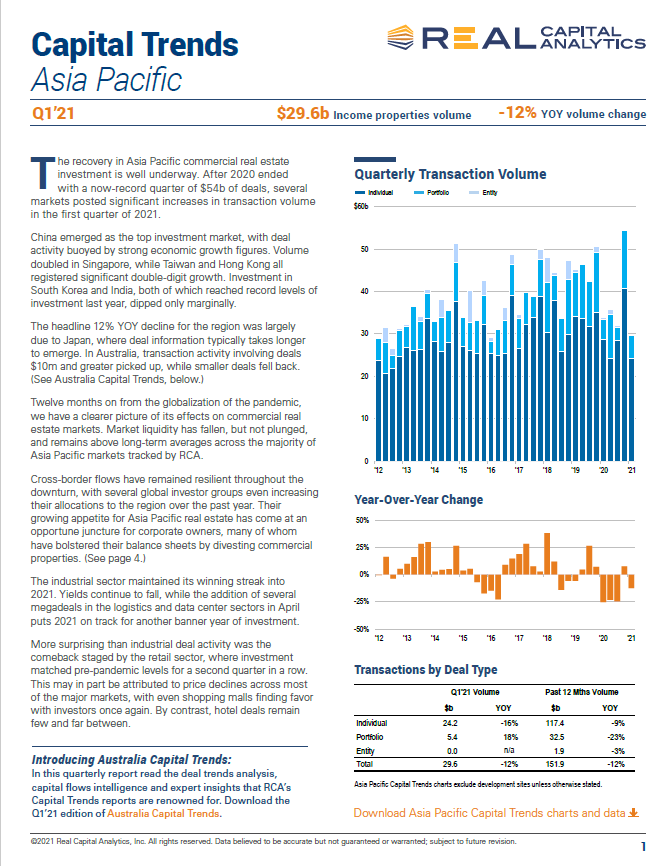
To view full report please visit Real Capital Analytics please visit : https://www.rcanalytics.com/rca-insights/

  • Global commercial real estate (CRE) investment volume fell by 31% year-over-year in Q1 2021. A strong rebound is expected in the second half of the year on the back of economic recovery and widespread COVID-19 vaccinations.
  • The pandemic has affected global investment markets to varying degrees. APAC led the global investment recovery in Q1. Markets like Tokyo, Seoul and Beijing showed resilience throughout the pandemic. Markets in North America, led by Los Angeles, Boston and Dallas, have recovered rapidly, while European markets lagged due to COVID resurgences.   
  • Industrial property investment remained strong in all three global regions. Hotel investment gained traction in the U.S. as prices dropped and distressed sales came to market. Core office and retail assets held up well in Asia Pacific.
  • Yield spread between property and bond narrowed based on rising bond yields across global markets. Global industrial yield continued to compress driven by strong market fundamentals and demand. Office yield remained stable in Q1 but showed signs of expansion in the U.S. Retail yield edged higher driven by softness in Europe.
  • Real estate total return remained positive in 2020 thanks to a stable income return. Many investors are turning to opportunistic and distressed investment in 2021 for higher returns. Greater emphasis is placed on tenant credit and rent roll growth under the influence of the pandemic.