
Knowledge Hub

China’s REIT market is entering a new growth phase as commercial property assets such as offices, hotels, retail, and mixed-use developments are incorporated into the public REIT framework. Regulatory enhancements and a more supportive interest rate environment are improving the relative appeal of C-REITs, creating compelling income-driven opportunities for both domestic and international investors. As the eligible asset base broadens and market depth increases, the C-REITs sector presents significant long-term potential.


Asia Pacific REITs are showing renewed momentum, with rising index performance, signs of recovery in key markets, and growing interest in sectors such as logistics, data centres, hotels, and healthcare. Technology and AI, better portfolio diversification, and increased focus on ESG are reshaping REIT strategies and narrowing the gap with US and European peers.

In our latest issue of APREA TrendWatch, we unpack these themes to show how APAC REITs are evolving from purely income-focused vehicles into dynamic platforms for long-term growth, innovation, and resilience.

The Market Shaper: George Hongchoy’s Journey from Accountant to Asia’s Real Asset Visionary

With four decades of experience and a record of reshaping Hong Kong’s investment landscape, Hongchoy leaves behind both a formidable legacy and a blueprint for growth.

For two decades, APREA has championed the growth and transformation of real assets across Asia Pacific. From advocating for REITs to embracing sustainability and digital innovation, APREA has been at the heart of the industry’s most significant milestones. This commemorative book captures that journey, celebrating the people, ideas, and connections that continue to define APREA’s role as a trusted voice for the industry

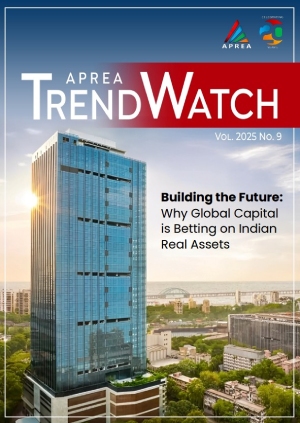
India’s real assets sector is entering a structural growth phase, underpinned by 6–7% GDP expansion, urbanisation to nearly 600 million city dwellers, and regulatory reforms that have created unprecedented transparency and scale. Investment opportunities now span a broad spectrum–from resilient office demand and premium residential to high-growth industrial, logistics, and alternative assets such as data centres, student housing, and senior living. With USD26.7 billion in recent equity inflows and REIT/InvIT platforms surpassing USD94 billion AUM, India has matured from a cyclical market into a core allocation for global investors seeking both stability and long-term upside.

Summary: Logistics rents across the Asia-Pacific region declined marginally by 0.4% YoY in H1 2025 due to cautious occupier sentiment and shifting supply chain strategies. Despite the overall slowdown, India and Brisbane showed strong rental growth, while most Chinese markets continued to face pressure from rising vacancies and oversupply.

  • India led the region in rental growth (+3.4%) driven by manufacturing, 3PL, and e-commerce demand.
  • Brisbane recorded >5% YoY rental increase but faced rising vacancies and incentives.
  • China saw continued rent drops due to oversupply; vacancy rates in Beijing and Shanghai exceeded 25%.

Outlook for H2 2025 includes slower leasing, more tenant-favourable conditions, and growing focus on strategic, resilient logistics hubs across the region.

Economic Rent and New Office Development: Increasing construction costs, rising land values, and asset repricing are leading investors to scrutinise theoretical rents more closely when planning new office developments. Investors are looking more closely at ‘economic rents’, which measure the rental income needed to justify development costs and are reassessing office developments across the region. 

Regional Variations:  Most markets in Asia Pacific have reported significant growth in economic rents over the past five years, led by Australia. In Asia, Singapore, Seoul and Beijing have seen the greatest growth.

Postponed New Office Developments: CBRE expects Asia Pacific office developments will continue to be postponed as investors find it difficult to justify commencing work on new schemes. This will constrain the supply pipeline in the medium term. As a result, the region’s office markets will adjust to the tighter supply-demand imbalance, which will help rental growth align with the change in construction and land costs.

Office Investment Hotspots: With the office outlook improving and pricing at the top of cycle in most APAC markets, investors are expected to continue to target acquisitions of existing stock. Markets with strong rental prospects such as Australia, Japan, India, and Korea, will attract investment demand in H2 2025.

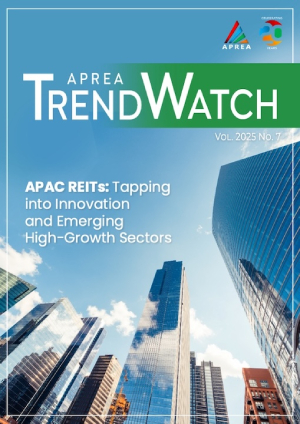
The Asia Pacific region is witnessing a transformation in its REIT landscape as structural shifts, driven by digitalisation, demographic change, and sustainability imperatives, are reshaping how capital is allocated and where future growth lies.

In our latest issue of APREA TrendWatch, find out how REITs in the region are now pivoting towards emerging, high-growth sectors, such as data centres, life sciences, logistics, and rental housing.

GARBE’s ROOTS development in Hamburg raises the bar for sustainable urban design as Germany’s tallest timber hybrid high-rise. Completed in Q1 2024 in HafenCity, the 19-storey building combines prefabricated timber with a concrete core, achieving a balance between structural safety, material efficiency, and carbon reduction. With a mixed-use programme and innovative use of natural materials, ROOTS offers a blueprint for high-density, low-carbon living and reflects the growing role of timber in sustainable construction.

In Singapore, investment remains buoyant despite operating performance normalising along with new supply; Indonesia hotel performance mixed as investment liquidity remains a challenge; Strong tourism growth in Vietnam boosts hotel performance and lures new investors.